Project 01
AI Content Attribution Pipeline
- 2
- independent signals
- 3
- attribution outcomes
- 50+
- automated tests
Problem and approach
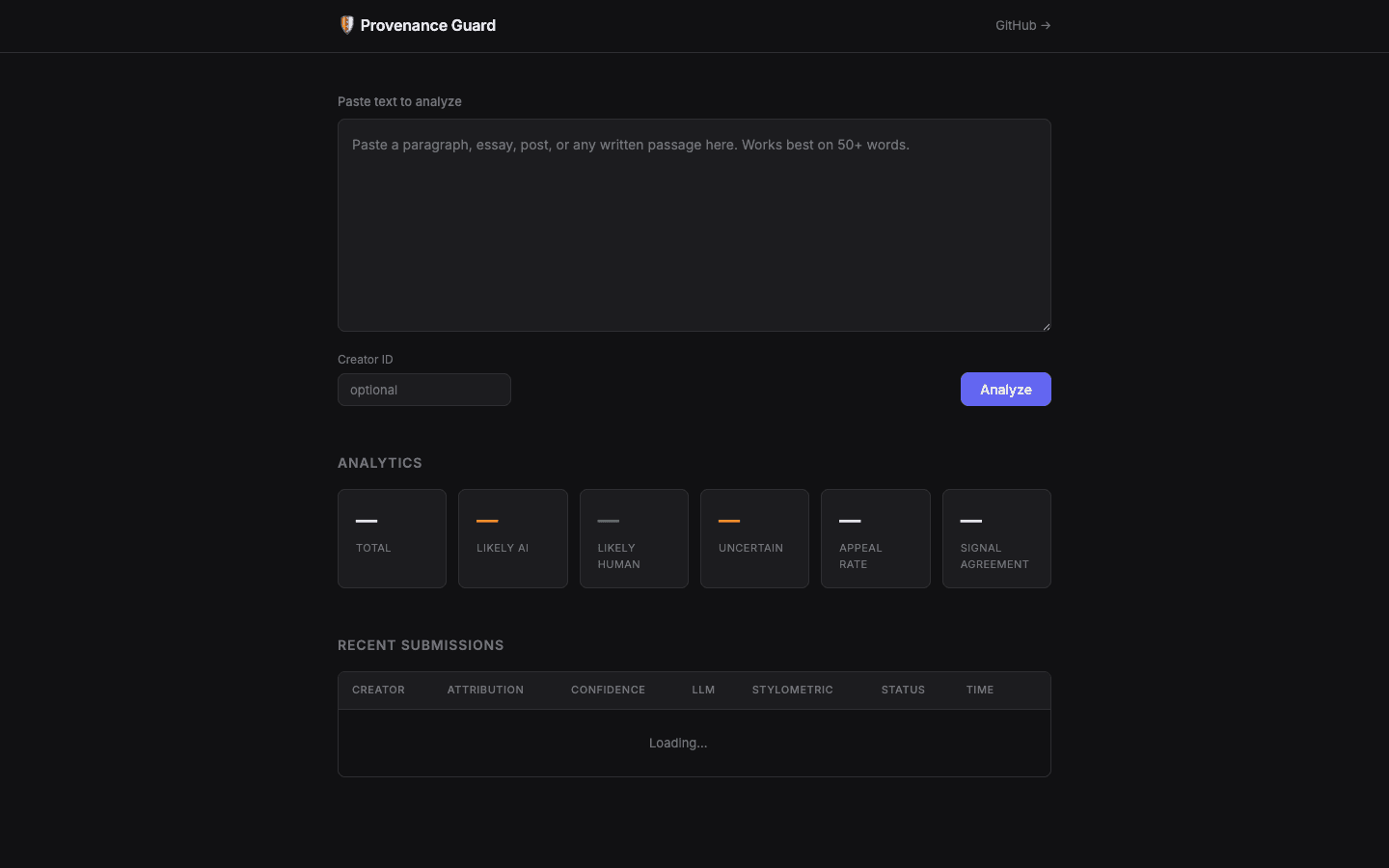
The system accepts submitted text and evaluates it through two independent signals. A Groq-powered LLM classifier looks at tone, phrasing, and structure, while pure-Python stylometric heuristics measure sentence-length uniformity, vocabulary diversity, and punctuation density.
A confidence scorer combines both signals and returns one of three outcomes: likely AI, uncertain, or likely human. The uncertain state is intentional; it prevents a borderline score from being presented as a definitive accusation.
Transparent product behavior
Each result includes a confidence score and a plain-language transparency label. Submissions are recorded in SQLite with both input signals, the combined decision, and its timestamp. An appeal workflow attaches a creator’s reasoning to the same record for later human review.
Evaluation changed the implementation
More than 50 automated tests cover scoring, labels, storage, classifier failures, and stylometric behavior. Evaluation exposed unreliable behavior on short inputs, so I recalibrated signal weighting instead of treating the first implementation as final.
Known limits
Stylometric statistics become unstable when there is too little text, and lightly edited AI writing remains difficult for both signals. The system is a decision-support prototype with explicit uncertainty and human review concepts—not proof of authorship.